
Market review: Bond yields march higher
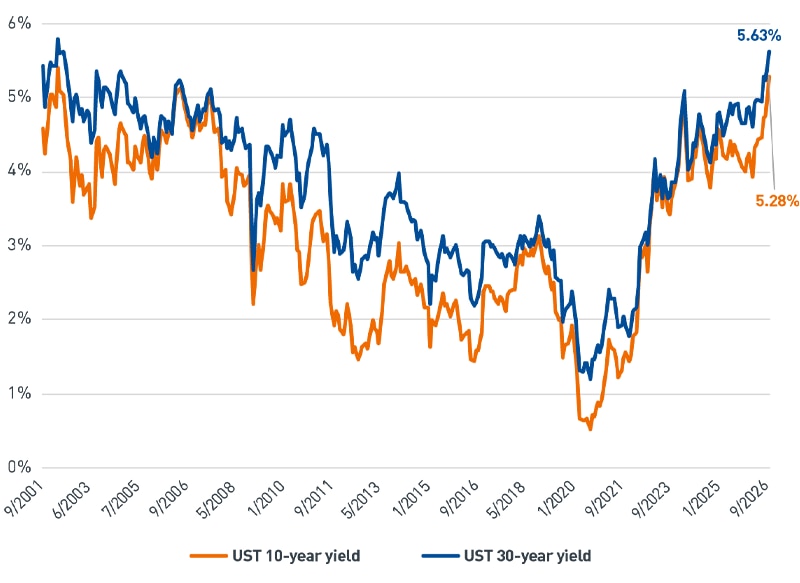
A global bond selloff drove markets lower in September, as longer-term yields in the U.S. rose to their highest levels since 2002 (Figure 1). A combination of inflation and debt concerns, coupled with stronger economic growth expectations, weighed on markets. The S&P 500® was modestly lower for the month. Artificial intelligence-related stocks outperformed, while smaller-capitalization, developed international and interest-rate-sensitive stocks underperformed.
In an effort to combat inflation, the Federal Reserve (Fed) hiked the fed funds rate for the first time since 2023, joining other global central banks in what may be the start of a new rate-hiking cycle. Crude oil prices retreated from their mid-month peak but remain at their highest levels since July, as the U.S.-Iran conflict continues.
Figure 1. 10-year and 30-year UST Yields
Long-term bond yields have risen to levels not seen in decades
As of 9/30/2026. Source: Bloomberg L.P.
View accessible version of this chart.
Short takes: Fixed income and the yen
- In early September, Treasury Secretary Scott Bessent famously quipped, “I am the house now,” in response to questions about Treasury intervention to support the weakening yen.
- Japan is the largest foreign holder of U.S. Treasury (UST) securities, and a weakening yen can pressure investors in Japan to sell USTs to buy more yen.
- The interconnectedness of the two markets highlights the complex backdrop of the Treasury market and comes at a time when the Fed is raising rates, which strengthens the U.S. dollar and, in theory, should continue to pressure the yen.
The big picture: Unbreakable bonds?
At the September 16 Federal Open Market Committee meeting, the Fed raised the fed funds rate by 25 basis points, bringing the policy rate to a 3.75%-4% target range. Following the hike, shorter-maturity UST yields rose, as did expectations for additional policy tightening. The widening spread between the fed funds rate and the 2-year UST yield suggests investors expect the Fed to continue to tighten policy.
The market is currently positioned for at least one more hike this year and another in the first quarter of 2027. The yield curve flattened for much of September before reversing, with shorter-term USTs yielding modestly below longer-term USTs. While the yield curve is not as inverted as it was a few years ago, the current spread between 2-year and 10-year UST yields remains below long-term averages.
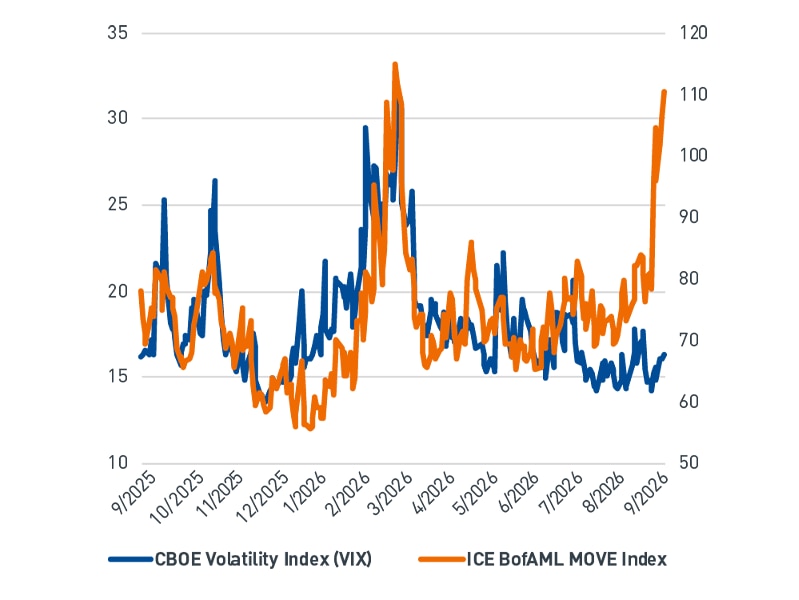
Equity market volatility has remained subdued despite the uncertain macroeconomic backdrop; in contrast, volatility in the bond market has surged alongside rising yields. In September, the Intercontinental Exchange Bank of America Merrill Lynch U.S. Bond Market Option Volatility Estimate Index (MOVE Index), which measures interest rate volatility, experienced its largest two-day increase since April 2025, creating a clear divergence in volatility between the two asset classes (Figure 2).
Figure 2. Stock and Bond Market Volatility
With the rise in bond yields, asset class volatility diverged in September
As of 9/30/2026. Source: Bloomberg L.P.
View accessible version of this chart.
Rising bond yields are not a phenomenon limited to the United States. Global sovereign yields have also climbed to decade highs as many countries grapple with similar issues of debt and inflation. In fact, a Bloomberg measure of global government bond yields has climbed to its highest level since 2007, reflecting pronounced moves higher in other developed markets such as Europe and Japan. France, in particular, is facing a significant debt challenge. Unresolved budget deficits, higher borrowing costs and political uncertainty have contributed to a widening in the spread between government bonds in France and those in Germany. The spread has reached the highest level since the 2011 Eurozone debt crisis.
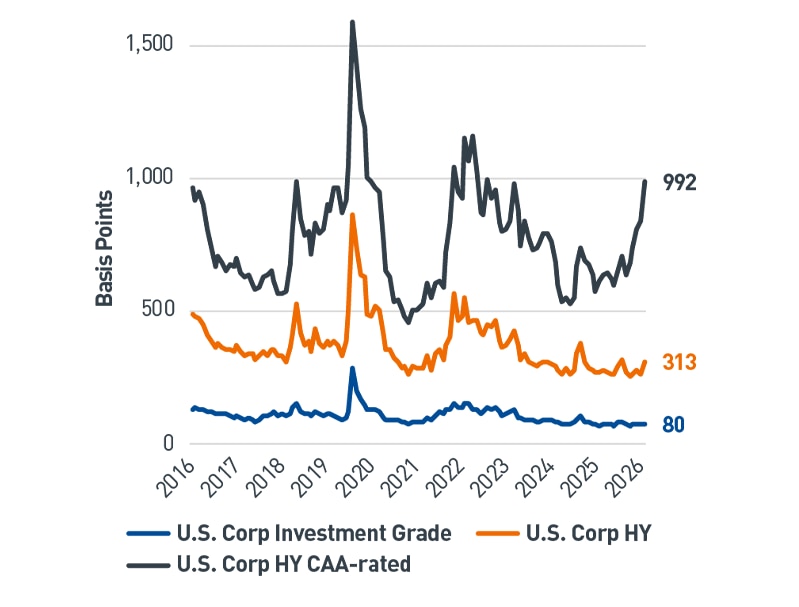
Credit spreads, or the difference in yield between USTs and bonds with varying levels of credit risk, have been tight for years. In September, spreads widened alongside higher bond yields and increased volatility, although investment grade and high yield corporate spreads remain tethered well below long-term averages. Credit spreads have risen most notably in the riskiest, lowest-rated tier of high yield bonds, though they remain below the crisis levels reached in 2020 and 2008 (Figure 3). Even with widening credit spreads, particularly for the lowest-rated junk bonds, there have been no signs of contagion and defaults have remained low.
Figure 3. Corporate Credit Spreads
The biggest widening in credit spreads has occurred in the lowest-rated tier of corporate high yield bonds
As of 9/30/2026. Source: Bloomberg L.P.
View accessible version of this chart.
Outlook and portfolio positioning
Rising global bond yields and elevated government borrowing remain key risks to our near-term outlook. However, yields have not risen to levels that, in our view, would materially reprice equities, and economic activity has remained resilient. We maintain our modest tilt towards diversified equities over fixed income as the fundamental backdrop remains supportive and we expect earnings growth to remain healthy in the coming quarter. Within fixed income, we favor short to intermediate maturity bonds given the relatively flat yield curve environment, in which investors are not being compensated for the duration risk of longer-maturity bonds.
TEXT VERSION OF CHART
Figure 1. 10-year and 30-year UST Yields (view image)
Long-term bond yields have risen to levels not seen in decades
Date | UST 10-year yield | UST 30-year yield |
9/2001 | 4.59% | 5.42% |
6/2003 | 3.51% | 4.56% |
7/2005 | 4.28% | 4.47% |
9/2006 | 4.63% | 4.76% |
5/2008 | 4.06% | 4.71% |
1/2010 | 3.58% | 4.49% |
9/2011 | 1.92% | 2.91% |
5/2013 | 2.13% | 3.28% |
1/2015 | 1.64% | 2.22% |
8/2017 | 2.12% | 2.73% |
5/2018 | 2.86% | 3.03% |
1/2020 | 1.51% | 2.00% |
9/2021 | 1.49% | 2.04% |
9/2023 | 4.57% | 4.70% |
1/2025 | 4.54% | 4.79% |
9/2026 | 5.28% | 5.63% |
As of 9/30/2026. Source: Bloomberg L.P.
Figure 2. Stock and Bond Market Volatility (view image)
With the rise in bond yields, asset class volatility diverged in September
Date | CBOE Volatility Index (VIX) | ICE BofAML MOVE Index |
9/30/25 | 16.28 | 77.93 |
10/31/25 | 17.44 | 66.61 |
11/28/25 | 16.35 | 68.95 |
12/31/25 | 14.95 | 63.96 |
1/30/26 | 17.44 | 59.2 |
2/27/26 | 19.86 | 73.38 |
3/31/26 | 25.25 | 96.05 |
4/30/26 | 16.89 | 72.07 |
5/29/26 | 15.32 | 70.22 |
6/30/26 | 16.45 | 71.96 |
7/31/26 | 15.99 | 83.02 |
8/31/26 | 14.92 | 75.32 |
9/30/26 | 16.34 | 110.45 |
As of 9/30/2026. Source: Bloomberg L.P.
Figure 3. U.S. Corporate Credit Spreads (view image)
The biggest widening in credit spreads has occurred in the lowest-rated tier of corporate high yield bonds
Date | U.S. Corp Investment Grade | U.S. Corp HY | U.S. Corp HY CAA-rated |
9/30/16 | 138 | 482 | 919 |
9/29/17 | 101 | 348 | 650 |
9/28/18 | 105 | 315 | 574 |
9/30/19 | 115 | 373 | 885 |
9/30/20 | 136 | 521 | 964 |
9/30/21 | 84 | 287 | 522 |
9/30/22 | 158 | 551 | 1155 |
9/29/23 | 120 | 395 | 846 |
9/30/24 | 88 | 300 | 689 |
9/30/25 | 73 | 270 | 616 |
9/30/26 | 80 | 313 | 992 |
As of 9/30/2026. Source: Bloomberg L.P.