
The institutional investment management industry has two primary service models: the traditional consultant model and the outsourced chief investment officer (OCIO) model. It is important to understand what services each typically offers and what responsibilities the decision-makers, such as board or investment committee members, retain in the relationship.
In the traditional consultant model (non-discretionary), an organization contracts with the consultant to provide services such as advising on the investment policy statement (IPS), consulting on asset allocation, recommending investment managers and monitoring performance. In this relationship the investment committee makes the final decisions after the consultant provides information and makes recommendations.
Engaging in an OCIO relationship (discretionary) entails outsourcing some or all investment management decisions to an OCIO provider. In an OCIO relationship, the investment committee provides governance and adopts an IPS for the portfolio. The OCIO must adhere to the IPS framework and guidelines when managing the portfolio. Typical responsibilities of the OCIO provider include portfolio rebalancing, tactical asset allocation decisions, manager selection and performance reporting.
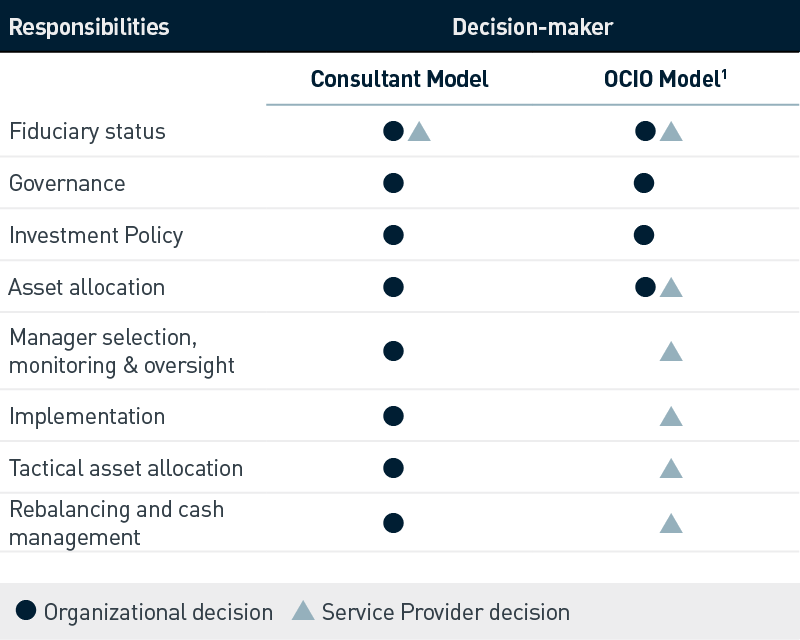
View accessible version of this chart.
Considerations
- Define success. What responsibilities do you want to retain or outsource?[2]
- Time is valuable. Where is the committee’s time most impactful for success? Do they have the resources and time to make the necessary investment decisions?
- Setting the long-term strategy is critical to success. A transparent provider should be flexible and work with you and tailor to your needs. What steps would the committee want to be actively involved with during the investment process?
Accessible Version of Chart
Responsibilities | Decision-maker in consultant model | Decision-maker in OCIO model |
Fiduciary status | Organizational decision and service provider decision | |
Governance | Organizational decision | Organizational decision |
Investment policy | Organizational decision | Organizational decision |
Asset allocation | Organizational decision | |
Manager selection, monitoring & oversight | Organizational decision | service provider decision |
Implementation | Organizational decision | service provider decision |
Tactical asset allocation | Organizational decision | service provider decision |
Rebalancing and cash management | Organizational decision | service provider decision |