
Corporate defined benefit plan funded levels increased during the third quarter of 2026. The primary drivers were positive returns in return-seeking assets and higher discount rates, as rising Treasury rates and modestly wider credit spreads decreased liabilities. A typical return-driven plan with higher equity allocations experienced an 8.1% increase in its funded ratio, while a typical liability-driven plan observed a 1.8% increase. Year to date, the sample return-driven plan funded ratio has increased approximately 15.2%, while a liability-driven plan has increased approximately 3.9%.
Chart 1: Funded Ratio Change: Return-Driven Plan1
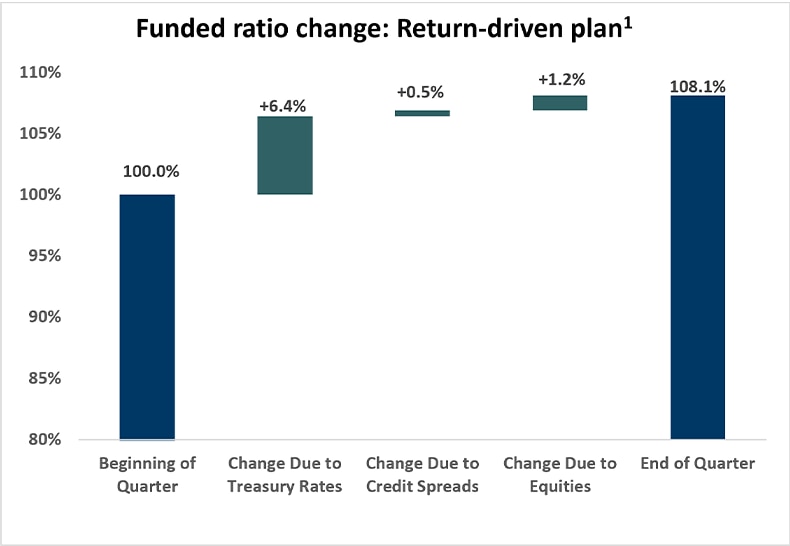
View accessible version of this chart.
Chart 2: Funded Ratio Change: Liability-Driven Plan1
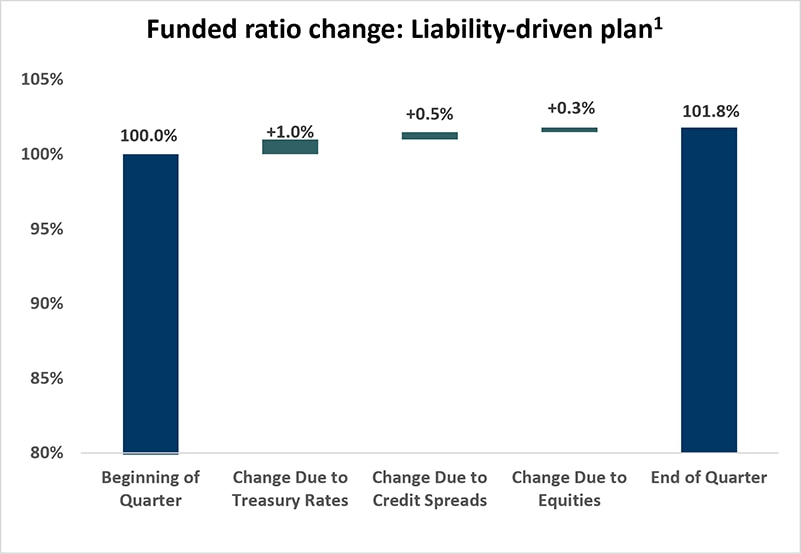
View accessible version of this chart.
Treasury Rates
Treasury rates increased and had a positive impact on funded status.
Treasury rates rose across all maturities, with the largest increases in the intermediate range. Short to intermediate rates increased approximately 50 to 90 basis points (bps), while long-term rates increased approximately 70 bps. Higher rates reduced pension liabilities, improving funded ratios. Return-driven plans gained more, while liability-driven plans saw more muted improvement as losses on long-duration fixed income partially offset the liability decline.
Chart 3: Treasury Curve2
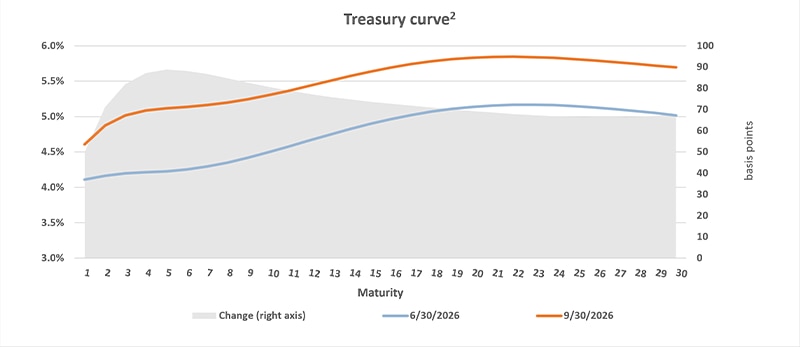
View accessible version of this chart.
Credit Spreads
Credit spreads widened and had a positive impact on funded status.
Widening credit spreads increased the discount rates and decreased liabilities. Intermediate duration credit spreads widened 6 bps while long duration credit spreads widened 7 bps. The overall increase in spreads was driven by a modest increase in credit risk premiums amid persistent inflation concerns and late-cycle market uncertainty. On a net basis, considering the increase on the Treasury curve, the total corporate bond discount rate for pensions increased approximately 76 bps.
Chart 4: Credit Spreads2
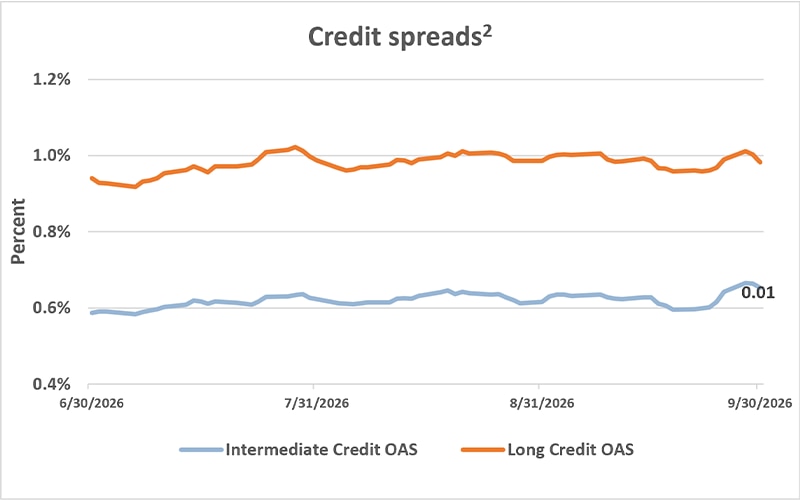
View accessible version of this chart.
Equities
Equity market performance had a positive impact on funded status.
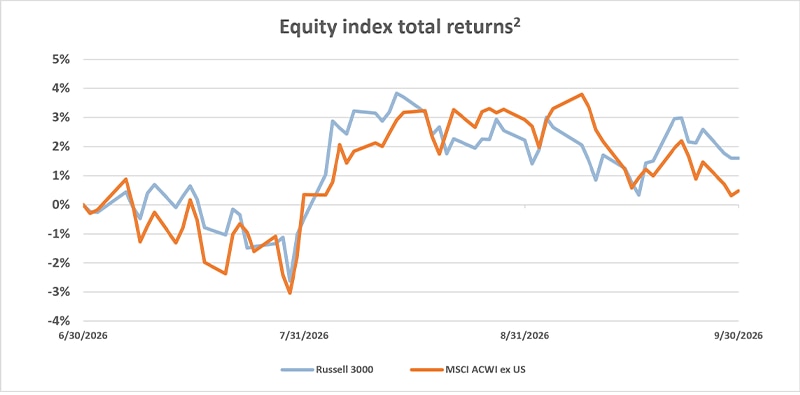
Overall positive performance increased funded statuses this quarter, driven by stronger-than expected corporate earnings and continued artificial intelligence capital spending. US large-cap stocks outperformed US small-cap stocks with returns of approximately 2.30% and -7.23%, respectively. International equities underperformed domestic equities and returned around 0.48%.
Chart 5: Equity Index Total Returns2
View accessible version of this chart.
1Assumptions
- Data as of 9/30/2026, Source: PNC.
- The funded ratio changes are for generic plans with allocation and liability profiles specified below. Results are market driven and do not incorporate any plan-specific effects, such as benefit payments, expenses, benefit accruals or plan contributions. Funded ratio changes are sensitive to the beginning of the period funded ratio.
- A return-driven plan is a pension plan with an asset allocation commonly associated with an absolute return-objective and has a high allocation to return-seeking assets (public equity in this case) and typically has high funded status volatility. Assumed asset allocation is 70% MSCI All Country World, 30% Bloomberg Aggregate.
- A liability-driven plan is one that is well along its path in a liability-centric approach to investing and has a large allocation to long-duration bonds to help reduce funded status volatility. Assumed asset allocation is 20% MSCI All Country World, 64% Bloomberg Long Credit, 16% Bloomberg Long Government.
- Liability profile is based on BAML Mature/Average U.S. Pension Plan AAA-A Corp Indexes with average duration of 12.2 years.
2Data as of 9/30/2026, Source FactSet®. FactSet® is a registered trademark of FactSet Research Systems Inc. and its affiliates.
Contact Us »
Accessible Version of Charts
| Return-Driven Plan | Funded Ratio Change |
| Beginning of Quarter | 100.0% |
| Change due to Treasury Rates | 6.4% |
| Change Due to Credit Spreads | 0.5% |
| Change Due to Equities | 1.2% |
| End of Quarter | 108.1% |
| Liability-Driven Plan | Funded Ratio Change |
| Beginning of Quarter | 100% |
| Change due to Treasury Rates | 1.0% |
| Change Due to Credit Spreads | 0.5% |
| Change Due to Equities | 0.3% |
| End of Quarter | 101.8% |
| Maturity | 6/30/2026 | 9/30/2026 | Change (right axis) |
| 1 | 4.11% | 4.61% | 0.5 |
| 3 | 4.20% | 5.02% | 0.82 |
| 5 | 4.23% | 5.12% | 0.89 |
| 7 | 4.29% | 5.16% | 0.87 |
| 9 | 4.42% | 5.24% | 0.82 |
| 11 | 4.58% | 5.37% | 0.79 |
| 13 | 4.74% | 5.50% | 0.76 |
| 15 | 4.90% | 5.63% | 0.73 |
| 17 | 5.02% | 5.74% | 0.72 |
| 19 | 5.11% | 5.81% | 0.7 |
| 21 | 5.16% | 5.84% | 0.68 |
| 23 | 5.17% | 5.84% | 0.67 |
| 25 | 5.15% | 5.81% | 0.66 |
| 27 | 5.11% | 5.77% | 0.66 |
| 29 | 5.05% | 5.72% | 0.67 |
| Date | Intermediate Credit Option-Adjusted (OAS) | Long Credit Option-Adjusted Spread (OAS) |
| 6/30/2026 | 0.59 | 0.94 |
| 7/31/2026 | 0.62 | 0.99 |
| 8/31/2026 | 0.62 | 0.99 |
| 9/30/2026 | 0.65 | 0.98 |
Chart 5: Equity Index Total Returns2
| Index | Date | Percent |
| Russell 3000 | 6/30/26 | 0.00 |
| 7/31/26 | -0.49 | |
| 8/31/26 | 2.21 | |
| 9/30/26 | 1.60 | |
| MSCI ACWI ex USA | 6/30/26 | 0.00 |
| 7/31/26 | 0.34 | |
| 8/31/26 | 2.92 | |
| 9/30/26 | 0.48 |