
The approaching 2026 U.S. midterm elections have been generating intense investor interest. We believe this is in part due to the narrow majority the Republican party currently maintains in both the House of Representatives and Senate. Historically, the sitting president’s party has tended to lose seats in midterm elections; on average, losing 27 House seats and three Senate seats across the past 23 midterms, according to Strategas Research Partners, Inc. If a similar shift were to come to fruition on November 3, control of the House would shift to the Democratic party and the Senate would be split 50-50, with Republicans retaining control through the vice president’s tie-breaking vote.
That said, we believe relying on historical averages of lost or gained Congressional seats masks the potential for large or unexpected swings. For example, in the 1994 and 2010 midterm elections, the party in the White House (Democrats) lost significantly more House seats than expected, while in 2022 they lost considerably fewer House seats than expected. Low voter turnout — and high variability of that turnout — in midterm election years has contributed to the difficulty in predicting midterm election outcomes.
In this article, we discuss additional financial market considerations, portfolio allocation implications and other factors related to the 2026 midterm elections.
How much do election results impact financial markets?
In the long run, we believe markets are driven less by election outcomes and more by the economic and institutional structures that support innovation and growth. However, in the short run, election results can significantly impact financial markets — particularly when they augur unexpected changes in the direction of tax and spending policies or result in sector-specific policy changes relevant to the Health Care or Energy sectors.
Historically, equity market performance has often been strongest under a divided government, i.e., one in which no single party controls the White House, the Senate and the House of Representatives. The rationale that a divided government limits policy swings and therefore allows the underlying economic forces to move forward may be generally sound, in our view, but there have also been exceptions, in which new policies have been well received by the market.
In recent decades, there has been a tendency for weaker returns in midterm election years and stronger returns in the year following midterms (Figure 1). However, the two weakest midterm election years of this century were in 2002 and 2022. We would argue, however, that the weak returns of those years were primarily driven by the unwinding of the dot-com bubble in 2002, and then the post-Covid inflation and interest rate spikes in 2022. Subsequently, the following bounce-back years 2003 and 2023 marked two of the three strongest third year returns in the post-2000 sample, with the S&P 500® up more than 25% in both years. The main takeaway from these data points is that distinct economic drivers are often more important considerations than historical patterns, in our view.
Figure 1. S&P 500 Annual Total Returns
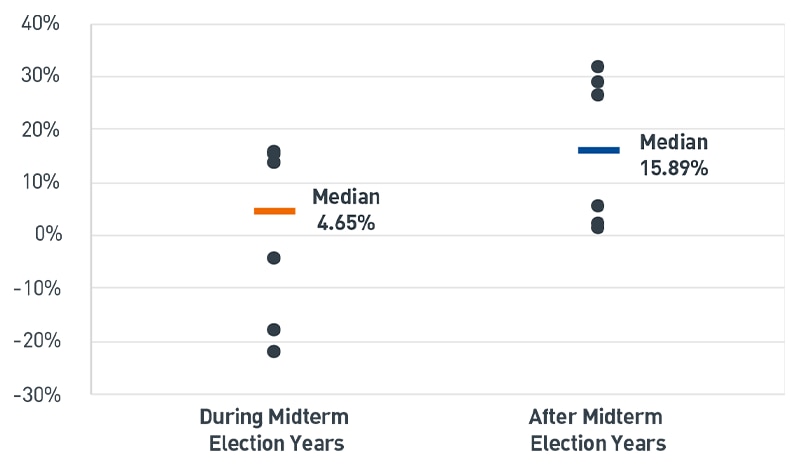
Source: PNC. For illustrative purposes only.
View accessible version of this chart.
We caution against using the political cycle calendar as investment guidance as near-term election uncertainty has rarely overcome the core drivers of market returns for an extended period. We expect consumer and corporate spending, inflation, monetary policy, fiscal policy, interest rates and valuations to remain the dominant market forces. We are using the midterm elections as a call to stay diversified in investment portfolios, avoid overreaction to campaign rhetoric and be aware of long-term opportunities that could arise due to short-term volatility.
Potential impacts of a change in Congressional control
We believe the investment implications of the November midterm election are likely narrow, at least as they pertain to direct impacts in 2027 and 2028. While legislative gridlock would likely prevail in most cases even if Democrats gain control of the House, Senate or both, there are areas in which more leverage would be possible. The range of topics that could see heightened debate in the midterm elections include health care, affordability, data-center limitations and clean energy.
There are 35 Senate midterm elections in November, with several, likely close, races. We expect the coming months to have a steady flow of polling results across these tight races, but persistent polling challenges — identifying “likely” voters and adjusting for differing response rates across parties — will likely remain. For these 2026 midterm elections, we believe that highly uncertain voter turnout warrants additional caution against putting too much emphasis on pre-election polling in tight races.
Artificial intelligence in the foreground of the midterm elections
Artificial intelligence (AI) has become an important political topic ahead of the midterm elections. In particular, the rapid proliferation of data centers and fears of a labor market fallout from AI-related impacts have contributed to growing opposition and even blurred traditional party lines on this issue. We expect data-center construction to be a prominent election issue.
Thus far, the tangible labor market impacts of AI have not been widespread, in our view. Job losses resulting from AI have been concentrated in certain technology roles, entry-level service positions and knowledge-based support roles. That said, we think that AI’s current limited impact on the labor market belies a deep angst among the workforce that AI is coming for jobs or that it will limit future opportunities. Tapping into this AI workforce angst could be a prominent election topic that centers on the notion of appropriate regulation and guardrails.
Maintain disciplined investing
We believe that it is important for investors to separate what may be perceived as high-stakes political outcomes from what constitutes direct investment implications.
In the long run, financial markets are driven more by the economic and institutional structures that support innovation and growth than by shorter-term political changes — particularly those without significant policy implications, in our view. Maintaining investing discipline, staying diversified and accepting the pre-election uncertainty that can hang over the markets remain as important as ever.
Figure 1: S&P 500 Annual Total Returns (view image)
| S&P 500® Annual Return in Midterm Election Years |
2002 | -22.10% |
2006 | 15.79% |
2010 | 15.06% |
2014 | 13.69% |
2018 | -4.38% |
2022 | -18.11% |
Median | 4.65% |
| S&P 500® Annual Return following Midterm Election Years |
2003 | 28.68% |
2007 | 5.49% |
2011 | 2.11% |
2015 | 1.38% |
2019 | 31.49% |
2023 | 26.29% |
Median | 15.89% |
Source: Morningstar, Inc. As of 6/30/2026.