
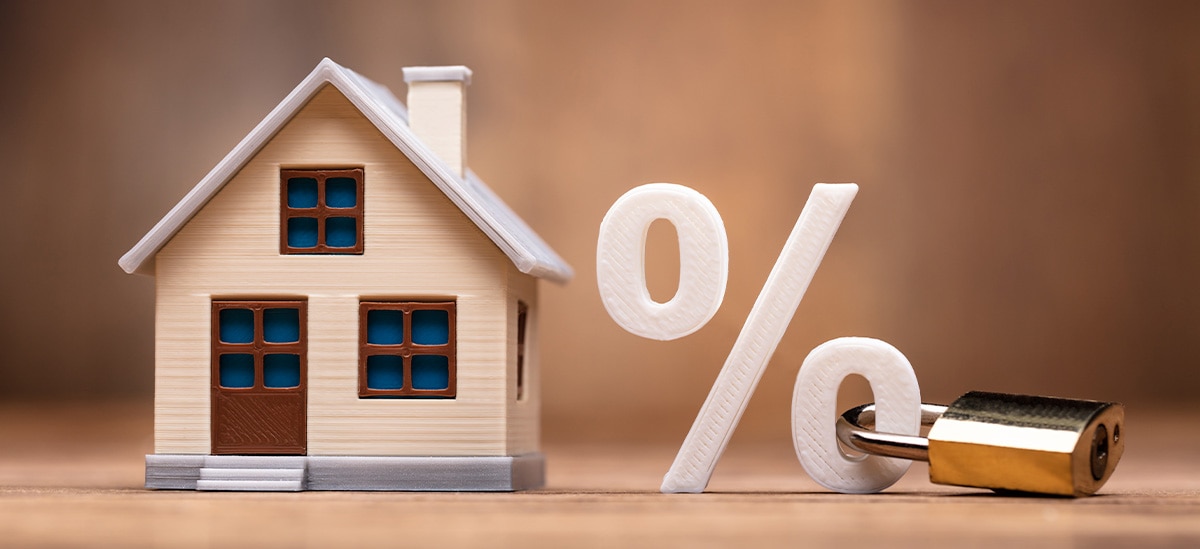
- Mortgage rate locks allow homebuyers to “lock in” the interest rate for a certain timeframe while their home loan is being finalized. This minimizes the risk that the quoted interest rate will rise before the buyers close on their new home.
- Rate locks are not guarantees that the buyer will get the locked rate. In some cases, a locked-in rate can be changed. For example, if the lock period expires or the buyer’s financial position changes during the period, a new rate may be quoted.
- Locking the interest rate may prevent you from taking advantage of lower rates if rates decrease before your home closes. Some buyers pay more for a float-down option, which gives them access to the lower rate as long as certain conditions are met.
With mortgage interest rates constantly fluctuating in response to ever-evolving market conditions, many homebuyers are curious to know what the rate on their future mortgage will be. Mortgage rate locks can reduce this uncertainty.
In this article, we’ll explain what mortgage rate locks are and how they work. You’ll also learn the pros and cons of rate locks so you can decide if a rate lock is the right choice for you.
Understanding Mortgage Rate Locks
A mortgage rate lock prevents your mortgage interest rate from changing before you close on your new home.
Once a mortgage lender approves you for a loan at a particular rate, the lender may allow you to “lock” in that rate for a set period (such as 30, 45, or 60 days, or perhaps longer). This provides some assurance that the rate on your future mortgage won’t be higher than your quoted rate.[1]
However, rate locks are not guarantees. There are certain situations in which your future mortgage rate may be different from the rate you lock in.[1] For example, if the rate lock expires before you close on the new house, or if your financial situation changes before closing, you may no longer qualify for the locked-in rate.
Many lenders charge fees for locking mortgage rates. There may also be fees for extending a rate lock or for allowing your rate lock to adjust downward if rates fall (which is known as a float-down option).[2]
Importantly, a rate lock does not lock you into the deal. You are still free to consider other offers or even change lenders.[2] However, changing your financing could delay your closing, or even provide the seller with a reason to terminate the purchase agreement.
Example of a Mortgage Rate Lock
Rate locks can potentially save homebuyers money by preventing the quoted rate from increasing with the market before closing.
As an example (for illustrative purposes only), assume that you’re getting a 30-year fixed-rate loan of $320,000 (fixed rate means that the interest rate remains the same for the life of the loan). After reviewing your credit score and finances, a lender quotes you an interest rate of 6.75% and offers a 45-day rate lock at no charge.
While your home purchase progresses toward closing day, the rate you would qualify for increases to 7%. However, because you locked the rate, you are still able to secure the loan at 6.75%.
This small quarter of a percentage point difference favorably affects your mortgage payment and overall interest expense. If your rate had been 7%, your monthly principal and interest payment would have been $2,129, and you would have paid $446,428 in interest over the term of the loan. At 6.75%, your monthly payment is $2,076, and you would pay $427,185 in total interest.
In this example, the rate lock reduces your monthly payment by $53 and saves you $19,243 in total interest expense.
You can use an online mortgage payment calculator to run numbers for your home purchase.
Benefits of Locking in a Mortgage Rate
Mortgage rate locks offer multiple advantages, including:
- Protection against rising interest rates. If interest rates increase after you apply for a mortgage, a rate lock keeps your lower rate in place until you close.[1]
- Budget certainty. With your rate locked, you can calculate your future principal and interest payments, making it easier to create your household budget.
- Peace of mind. You won’t need to stress about fluctuating rates while waiting for the deal to close.
- Potential for extensions. Most lenders offer rate lock extensions for a fee. This can help you keep your rate even if your closing is delayed for any reason.[1]
Costs and Risks of Locking in a Mortgage Rate
Before accepting a rate lock, you should be aware of a few potential downsides.
- Rate lock fees. Many lenders charge a fee for locking your rate. While rates vary by lender, it is common to see fees of .25%-.50% of the loan amount.[2] For example, a rate lock fee of .25% on a $320,000 loan would be $800. This fee may be rolled into the loan or paid at closing. There may be additional fees for float-down options, which allow your lock to adjust downward if rates decrease or if the rate lock period is extended.
- Risk of missing out on lower rates. Unless you get a float-down option (perhaps at a higher fee), your rate lock could trap you at a higher rate if rates fall while you’re waiting to close.
- Risk of the lock expiring. If you cannot close on your home before the rate lock expires, you may need to pay for an extension or accept a new, potentially higher rate.
Evaluating the Costs vs. Benefits of Rate Locks
Since it is impossible to know whether rates will increase or decrease from one day to the next, it is difficult to evaluate the costs vs benefits of rate locks. If rates increase and your lock secures you a lower rate, it will likely be worth the cost of the rate lock. However, if rates decrease or you have to pay for an extension on top of your initial rate lock fees, the lock might not be worth it.
Consider current market conditions and your own risk tolerance to help you weigh the costs and benefits. If rates are trending down, and there’s no reason to think they will turn around before your closing date, you might decide to forego the rate lock. However, if you prefer the certainty of a locked rate over the possibility of a slightly lower rate, you might decide to lock the rate for your own peace of mind.
How To Lock in a Favorable Mortgage Rate
Staying in close communication with your lender can help you lock in a favorable rate.
You can typically initiate a rate lock simply by asking your lender to lock the rate. However, it’s important to get the timing right. Locking in too early could put unnecessary pressure on the deal to close quickly. It’s generally advisable to wait until you have a house under contract before locking in your rate. If rates are actively falling, you may want to wait even longer, or potentially avoid locking the rate altogether. Lenders may require that you lock the rate well before closing (e.g., 15 days before closing) to leave enough time to draft necessary disclosures and closing documents for your signature.
It’s worth noting that your loan type may affect your rate-locking decisions. For example, government-backed loans (like VA loans, FHA loans, and USDA loans) may take longer to close due to additional underwriting requirements, so a longer lock period may be warranted.
Tips for Managing Rate Lock Extensions and Changes
Even with a rate lock in place, there are a few circumstances that could cause your actual interest rate to differ from the locked rate:[1]
- Your rate lock expires. If you don’t extend the lock before the expiration, the rate can adjust to prevailing rates. The cost of a lock extension varies by lender, but it may cost just as much as, or more than, the initial rate lock.[3] You may be better off paying for a longer initial lock period than buying an extension.
- You have a float-down option, and interest rates decrease. If you have a float-down option in place, and interest rates decrease, your lock may automatically come down to the new, lower rate. However, some lenders require that the rate come down by a certain amount before they will change your rate. For example, you might only get the new rate if rates drop by at least .2%.
- Your financial position changes during the lock period. If your income, assets, debt, or credit score materially change, the original interest rate quote may no longer apply. The lender will need to review your new financial position to determine what rate can be offered, given your revised finances.
- Your financial position cannot be verified. If the underwriter cannot confirm your income with satisfactory documentation, they may need to provide a new loan estimate based on the information they can verify.
- The loan materially changes. If the loan amount changes (perhaps because the appraised value is higher or lower than expected) or the interest rate type changes (perhaps because you decided to go with a fixed-rate mortgage over an adjustable-rate mortgage), the interest rate may change.
Final Thoughts on Mortgage Rate Locks
A mortgage rate lock can be a valuable tool for protecting your interest rate while you finalize your home purchase. However, it also comes with potential costs, limitations, and the risk of missing out if rates fall.
Your lender can help you navigate mortgage rate locks based on your financial profile, general market conditions, and your goals. Make sure you understand the terms of any proposed mortgage rate lock and ask your lender for clarification as needed.




 ©2026 The PNC Financial Services Group, Inc. All rights reserved.