

Bank Responsibly

Operating by our Values

PNC has long been an engaged and responsible company rooted in the belief that meaningful relationships are built and strengthened through honest
and transparent dialogue and action. Our guiding principle across all our
businesses is to do right by our customers, employees, shareholders
and the communities we serve.

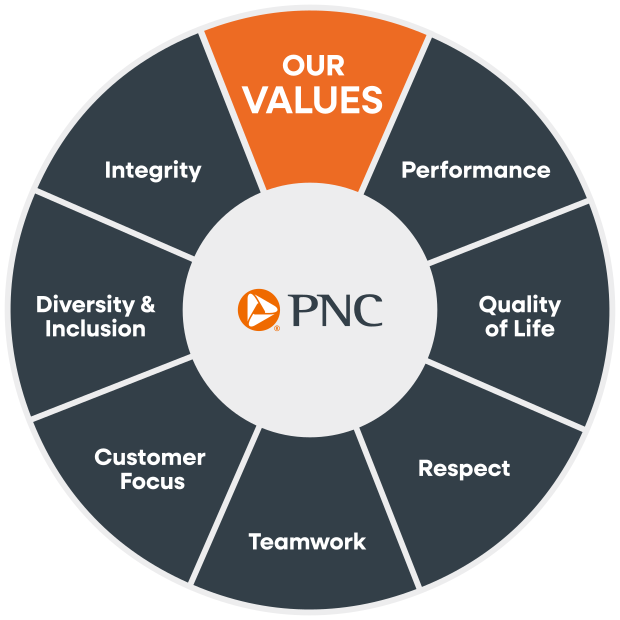
PNC has a set of values that drive our behavior and reflect our priorities. We hold all employees and managers accountable for demonstrating our values with customers and with one another. Upholding our values is critical to our success — and that of our customers and the communities we serve.  

  • Customer Focus
    We offer products, services and experiences that fulfill our customers’ financial needs and goals in a clear and transparent way, while delivering on the commitments we make to them.
  • Diversity and Inclusion
    We value our differences and work together to create a diverse and inclusive workplace where everyone can contribute to the success of our company.
  • Integrity
    We are honest, do the right thing, conduct business with the highest ethical standards and enable our colleagues to raise concerns.
  • Performance
    We expect excellence in all that we do.
  • Quality of Life
    We promote the personal, physical and financial well-being of our employees, customers and communities.<
  • Respect
    We trust the capabilities, character and judgment of our colleagues, and treat each other with respect.
  • Teamwork
    We work together to achieve our goals and celebrate our successes.

Responsible Lending

Consistent with the requirements of the Equal Credit Opportunity Act (ECOA) and the Fair Housing Act (FHA), PNC is committed to providing fair, equitable and nondiscriminatory access to our credit products for all qualifying and potential consumers and businesses. To that end, PNC implements robust processes to design and deliver our products and services in a manner that prevents discrimination based on race or color; religion; national origin; sex (including sexual orientation and/or gender identity); marital status; age (provided the applicant has the capacity to contract); the applicant’s receipt of income derived from any public assistance program; physical disability; or the applicant’s exercise, in good faith, of any right under the Consumer Credit Protection Act in any aspect of a credit transaction.

It is the policy of PNC to conduct all lending activities, from marketing through the product life cycle, in accordance with fair lending laws while maintaining safe and sound credit standards. PNC’s Fair Lending program includes employee training, compliance support for PNC’s lines of business and monitoring of customer communications, lending activities.

Doing Right is a Brilliant Way To Do Business

PNC’s success is dependent upon our ability to create long-term value for our stakeholders. Our steadfast focus on smart risk management and relationship-based customer service builds the foundation to engage deeply and meaningfully across our stakeholder groups.

Enterprise Compliance Program

PNC is committed to maintaining a comprehensive Enterprise Compliance program to effectively manage risk that could arise from violations of laws, rules or regulations, including a failure to comply with practices and industry standards set by self-regulatory organizations. At PNC, the board has given our Risk Committee the responsibility to oversee our compliance program. Our chief compliance officer (CCO), who reports to the head of Enterprise Compliance, Operational Risk Management and Enterprise Testing Services, designs and oversees the program and its ongoing enhancement.

In addition to regularly reporting to the board, the CCO has the authority to identify and resolve compliance issues in a timely and effective manner, and to escalate issues promptly to the board and executive management as needed. Part of the Enterprise Compliance program is the execution of a policy framework approved by the Compliance Risk Committee. The framework includes scheduled policy reviews designed to ensure that our policies reflect current regulatory requirements.

PNC maintains a robust and effective Compliance Management System (CMS) program, which includes regulatory change management, internal monitoring, annual risk assessments and comprehensive compliance training.

PNC’s Bank Secrecy Act (BSA) / Anti-Money Laundering (AML) and Sanctions program is led by the chief AML officer, who reports directly to the chief risk officer (CRO). The program’s enterprise policy aligns with regulatory requirements and provides governance and oversight of PNC business units. The program sets forth minimum BSA/AML and sanctions standards designed to ensure that PNC is providing products and services and conducting business activities in compliance with applicable laws, rules and regulatory guidance. The chief AML officer provides program updates to multiple committees throughout the year.

Our enterprise policies address anti-bribery, anti-corruption, money laundering, terrorist financing, economic sanctions and import/export controls. All employees can and should report suspicious activity through established channels, including the PNC Business Conduct and Ethics Hotline, and by filing a Security Incident Report (SIR). Our AML program is designed to safeguard our communities, company and country from financial crime, money laundering and terrorist  financing.  

Every PNC employee must review, understand, and comply with all PNC policies. As such, we've implemented an annual, mandatory Compliance Training program that covers our policies and other compliance-related issues. Each year, all PNC employees are required to complete a Risk Refresher that includes BSA/AML, as well as an annual Privacy and Data Security training program. The board of directors also receives yearly dedicated AML training regarding regulatory updates, emerging developments in AML and combating the financing of terrorism/sanctions, notable enforcement actions, and changes in supervisory guidance and expectations.

For more information, visit our Global Financial Crimes Compliance.


Ethics Program

PNC requires our employees and our directors to act according to the highest ethical standards. Consistent with this expectation, PNC operates with seven core values that serve as the foundation of everything we do. They guide our ethical practices, define who we are, and drive the success of our company, customers and the communities we serve.

PNC’s Corporate Ethics Office is responsible for implementing our overall ethics program in support of our values and adherence to the law. As part of this program, the Ethics Office continues to enhance and implement PNC’s Code of Business Conduct and Ethics (Code), the internal Ethics and Conduct Policy (ECP) and other ethics-related policies. The Code is available in English and Spanish. In addition, the Corporate Ethics Office is responsible for PNC’s Enterprise Conduct Risk program, which measures our employees’ compliance with identified ethical standards.

The Code and the Enterprise Conduct Risk program documents are reviewed and approved annually by PNC’s board of directors’ Audit Committee. These documents are also reviewed by PNC’s leadership team and are updated as needed to reflect changing laws, rules and regulations, and any identified trends in behavior that need to be addressed.
 
The Code and related policies contain guidance and standards for employees to follow when conducting business on behalf of PNC. Any employee who violates the Code or otherwise fails to follow PNC’s ethical standards may be subject to disciplinary action, up to and including termination. PNC’s Code also details the multiple avenues by which employees can contact PNC’s Corporate Ethics Office to report ethical concerns, including through an anonymous PNC Business Conduct and Ethics telephone hotline or web portal. PNC requires employees to speak up if they are aware of behavior that is inconsistent with our values or the ethical principles established by PNC’s Code and related policies. In addition, the Corporate Ethics Office has robust anti-retaliation policies to protect employees who report concerns or suspected unethical behavior in good faith, regardless of an investigation’s outcome. PNC expressly prohibits retaliation of any kind against employees for reports of suspicious activity or violations of the Code.

Throughout their employment at PNC, all employees are required to complete annual training that reinforces their ethical obligations and the behavior PNC expects from them. Training topics include conflicts of interest, protection of customer data and business records, proper use of technology and electronic media, gifts and entertainment, and the importance of following all relevant laws and regulations. The training also addresses employees’ obligations to report ethics violations, and the process for seeking pre-approval or preclearance from the Corporate Ethics Office for certain activities.

The importance of ethical behavior at PNC is also highlighted through the annual performance review process. Every employee has a risk goal relating to their responsibility to act in an ethical manner. Moreover, as part of the annual performance review process, employees must also attest that they have read, understood and will comply with the Code and related policies. The performance metrics are in place to ensure that our employees are held accountable for the ethical implications of their work and understand the significance of relevant ethics policies. The Corporate Ethics Office also communicates regularly with employees and managers through articles and brief updates to remind them of their ethical responsibilities and requirements.

PNC also requires all suppliers and third parties to comply with our Supplier Code of Conduct (Supplier Code). The Supplier Code which outlines principles that are consistent with PNC’s strong commitment to ethics and integrity in our business dealings and is informed by the International Labor Organization’s Fundamental Conventions, the United Nations Universal Declaration of Human Rights, the United Nations Guiding Principles on Business and Human Rights, and the United Nations Global Compact.

PNC’s Corporate Ethics Office evaluates the continued effectiveness of the overall ethics program through an assessment of the concerns raised by employees and their resolution, an annual ethics survey provided to randomly selected employees, and information learned from the Enterprise Conduct Risk program. All these actions are in support of our deeply held commitment to ensuring that our employees, directors and others acting on behalf of PNC engage in ethical conduct in all they do.

Read our Code of Business Conduct and Ethics to learn about our ethics program.


Public Policy Approach

PNC’s Regulatory Affairs and Government Affairs functions, which report to our general counsel, provide regulatory and government affairs advice, respectively, to our strategic partners across PNC’s business units and functional areas. This counsel helps PNC develop our public policy strategy and manage key risks, including regulatory, compliance and reputational risks, and provides thought leadership and expertise on regulatory and legislative developments. PNC pursues our public policy objectives through:

  • Actively participating in trade associations and other forums
  • Developing industry and PNC comment letters on proposed regulations
  • Attending meetings with government and congressional representatives

Our Commitment to Human Rights

To better serve our stakeholders, it is important to have a clear vision and strong principles to guide our actions. PNC has long demonstrated a commitment to living our values and to corporate responsibility. That commitment has only deepened as we have grown into one of the leading financial services companies in the country. Our Values, Code of Business Conduct and Ethics (Code), and related policies, convey our areas of focus and serve as the foundation of this Human Rights Statement.

PNC understands the responsibilities that come with being a large financial services provider and adherence to our Code, compliance with laws and regulations, and support of fundamental human rights are cornerstones in conducting business with integrity and the highest ethical standards. PNC strives to make decisions that are grounded in our Values, consistent with our corporate responsibility commitments and reflective of our commitment to respect the human rights of all of our stakeholders who are impacted by our business operations.

Read PNC's Human Rights Statement.


At PNC, we’re committed to doing the right thing for our shareholders, customers, communities and employees.

For more information, read PNC's Modern Slavery Act Statement.

PNC also requires all suppliers and third parties to comply with our Supplier Code of Conduct (Supplier Code). It  outlines principles that are consistent with PNC’s strong commitment to ethics and integrity in our business dealings and is informed by the International Labor Organization’s Fundamental Conventions, the United Nations Universal Declaration of Human Rights, the United Nations Guiding Principles on Business and Human Rights, and the United Nations Global Compact.

For more information on how we engage with suppliers, download the Supplier Code of Conduct.

Related Resources

Security & Privacy

Customer Privacy and Security

Our customers trust us to safeguard the privacy of their personal and financial information —a responsibility that tops our list of priorities.

Corporate Responsibility

Corporate Governance

A strong foundation in governance helps drive our company’s success and positive reputation.

Financial Education Resources

Financial Access

We are committed to helping our customers take the next step forward in their financial lives — wherever they are in their personal journey.