





The State of AI: How Organizations Are Rewiring to Capture Value, McKinsey, Mar. 2025,
https://www.mckinsey.com/~/media/mckinsey/business%20functions/quantumblack/our%20insights/the%20state%20of%20ai/2025/the-state-of-ai-how-organizations-are-rewiring-to-capture-value_final.pdf

AI and the Future of Treasury
Optimizing Working Capital with Intelligence and Insight
AI AND THE FUTURE OF TREASURY
Optimize working capital with intelligence and insight
Automation is unlocking a new level of agility and precision in working capital management
Why AI matters for working capital
Automation is unlocking a new level of agility and precision in working capital management
Working capital rarely runs on autopilot. Treasury teams juggle liquidity monitoring, collections, and spending priorities, often across siloed systems that limit visibility and slow response times. The result? Fragmented dashboards and manual reconciliations that keep treasury reactive instead of strategic.
AI changes that. By unifying data across enterprise resource planning (ERP) and payment platforms, AI can automate repetitive tasks, anticipate cash shortfalls, and accelerate capital flow. More importantly, it frees treasury professionals to focus on high-value decisions, transforming working capital management from reactive to proactive.
Three AI capabilities driving treasury forward
Siloed systems keep treasury reactive, but AI can help transform disconnected data into proactive insight



What AI-powered treasury looks like
AI brings together intelligence and execution to help treasury move at the pace of the business
Imagine this: AI detects invoices trending four days late, calculates the liquidity cost, and recommends establishing a dedicated collections position for higher risk accounts, comparing staffing expenses to recovered cash.
Meanwhile, agentic AI rebalances payables and sweeps excess cash in real time. The result? Faster decisions, stronger collaboration, and treasury teams focused on strategy, not spreadsheets.

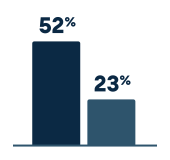
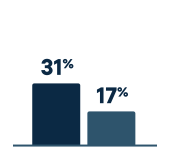
Larger organizations are following more adoption and scaling best practices for GenAI deployment than are smaller organizations[1]
Dedicated team to drive GenAI adoption
Role-based capability training courses
Practical “no-regrets” steps for treasurers preparing for GenAI
Even if full-scale AI adoption is a year or two away, treasury leaders can take steps now to help determine readiness

Firms have begun reskilling employees due to AI use, and expect increased reskilling in the next three years[1]
Share of the employees reskilled in the past year due to AI use
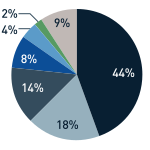
Percentage of respondents
Share of employees expected to be reskilled over the next three years due to AI use
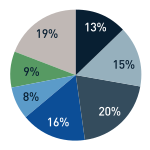
Percentage of respondents
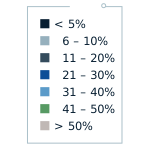
View accessible version of these charts.
The bottom line: human oversight still matters
AI amplifies treasury’s capabilities, but human judgment and governance remain essential
Even the most advanced algorithms require human direction. AI can surface risks and optimize scenarios, but it can’t independently weigh regulatory obligations, ethical considerations, or enterprise priorities, which reinforces the need for strategic oversight. According to McKinsey, 28% of organizations assign AI governance to the CEO, and 17% to the board, underscoring the need for leadership involvement.
Without guardrails, automation could optimize liquidity at the expense of payroll obligations, compliance requirements, or other critical priorities. Human experience helps confirm forecasts are validated and decisions align with enterprise goals.
The future of treasury lies in balance: automation accelerates analysis, while human oversight helps facilitate control. AI is not a replacement, it’s a catalyst for smarter, more agile working capital decisions.
Learn more about PNC's Treasury Management Platform.
TEXT VERSION OF CHARTS
Chart 1: Share of the employees reskilled in the past year due to AI use (view image)
Percentage of Employees Reskilled | Percentage of Respondents |
Up to 5% | 44% |
6 to 10% | 18% |
11 to 20% | 14% |
21 to 30% | 8% |
31 to 40% | 4% |
41 to 50% | 2% |
>50% | 9% |
Chart 2: Share of the employees reskilled in the past year due to AI use (view image)
Percentage of Employees Reskilled | Percentage of Respondents |
Up to 5% | 44% |
6 to 10% | 18% |
11 to 20% | 14% |
21 to 30% | 8% |
31 to 40% | 4% |
41 to 50% | 2% |
>50% | 9% |